
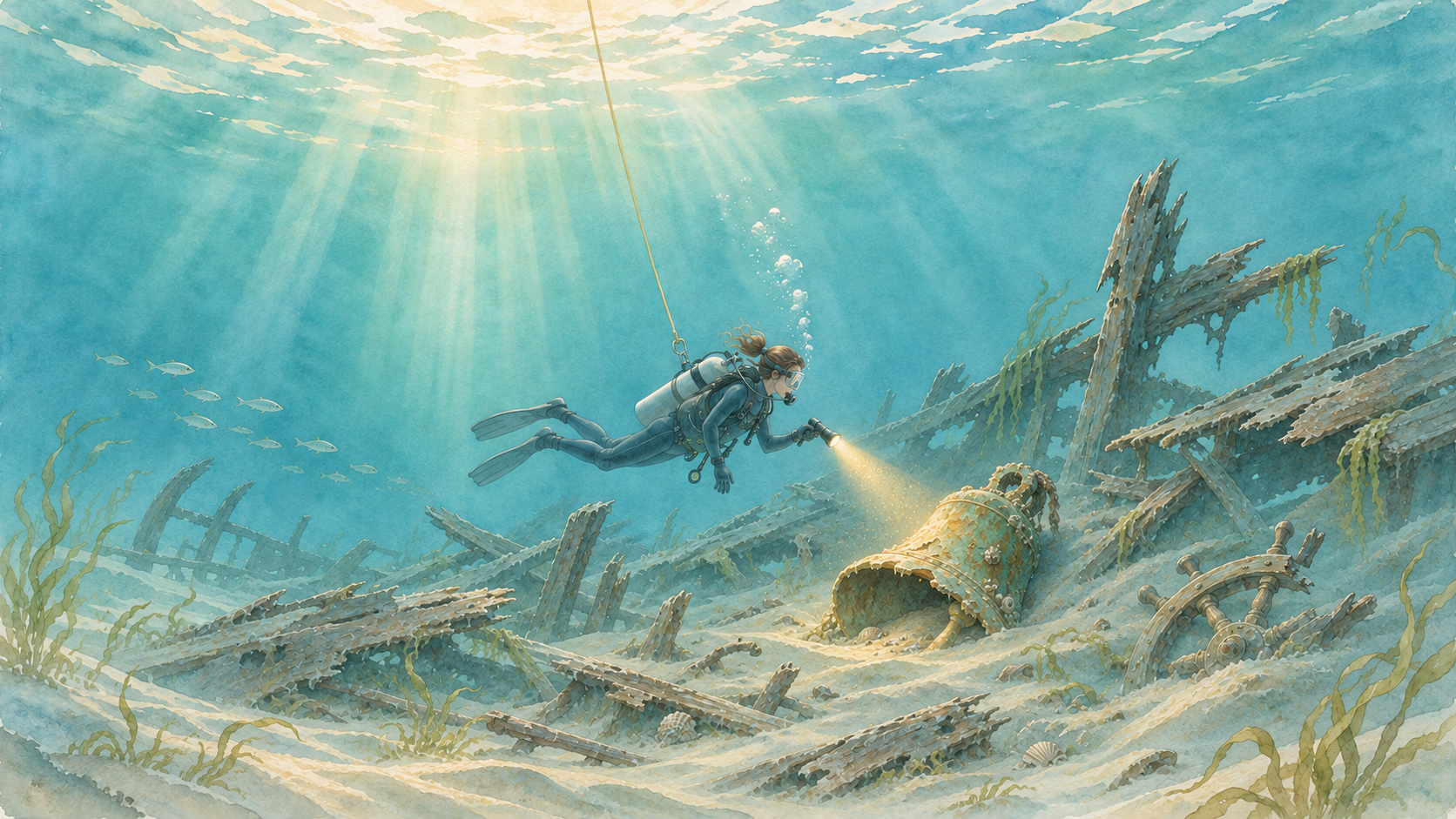
 Early in the pandemic, when the world had gone quiet and strange, I was part of a small online writing group. Each session began with a prompt, and one morning the group leader read us a poem by Adrienne Rich called Diving into the Wreck.
I don’t remember much of what I wrote that day. But I’ve never forgotten the title. It struck me as portentous, as if it were naming something I had been doing for most of my life without quite having the words for it.
Because that is what we do when we look back. We leave the bright, busy surface of the present and go down. Sometimes we hold our breath and make a quick dip. Sometimes we strap on the tanks and go deep. Either way, we are diving on the wreck of our own past.
What’s still down there
The first thing a diver learns is that the wreck is not the ship. Time and tide have been at work. Paint has gone, wood has rotted, whole decks have collapsed. Weed and sand cover most of it. Much of what was once there has simply washed away.
Memory is like that. We go looking for a childhood home, a first love, the family we grew up in, and find mostly silt. The details we were sure of turn out to be vague. Whole years are missing.
And yet some things survive. A diver swims along the hull and suddenly there it is: the ship’s bell, green with age but still a bell. The wheel. The unmistakable curve of the bow. You know at once what you are looking at.
I think we each have our own bells and wheels. The smell of a particular kitchen. A phrase a parent used. The view from a bedroom window. A song that was playing on the radio. These things last when so much else has gone.
Some of what we find down there is treasure. It is worth bringing back to the surface and keeping: a moment of tenderness we had forgotten, a talent we set aside, a version of ourselves we were fond of.
But some of it is something else. It is clues. A detail that doesn’t fit the story we have always told. A letter that suggests things were not quite as we believed. The realisation that a parent we blamed was struggling with more than we knew, or that one we idolised was not as kind as we thought. Clues like these can change what we think happened, and so change who we think we are.
The breathing apparatus
No sensible diver goes down to a wreck without the right equipment. The deep is cold and dark, and it is easy to become disorientated. People get tangled in old rigging, or stay down too long, or come up too fast.
The same is true when we dive into our past. Some of what lies down there is painful. Old grief, old shame, old fear can rise up and take our breath away. Going down alone and unprepared is not brave. It can be dangerous.
Over many years as a psychotherapist, I have sat with people as they made this dive. What I have learned is that the breathing apparatus matters as much as the courage. For some it is therapy: a trusted person on the boat above, keeping hold of the line. For others it is a good friend, a partner, or a group of people who have been down to similar depths. For many of us, and certainly for me, it is writing. Putting words on a page gives us a way to go down, look around and come back up again in one piece.
It also helps to remember that we don’t have to see everything at once. A diver explores a wreck over many trips. Each time they go a little further, notice a little more and bring a little more back. There is no prize for staying down until you run out of air.
Bringing it back up
We don’t dive on the wreck just to look. We dive to bring something back.
When we bring something back, the present changes too. A piece of treasure, held in the light, can remind us of what we still value and who we still are underneath the years. A clue, once understood, can loosen an old knot. We may forgive someone, or forgive ourselves. We may finally see why we have kept repeating the same pattern, and find that we no longer need to.
I have been doing a lot of diving myself lately, writing about my own family and the generations that came before me. I have found some treasure and a surprising number of clues. Each time I come back up, the surface looks a little different. That, I think, is the real point. The past cannot be changed. But what we find there can change how we live now.
So, if you feel the pull to look back, I’d encourage you to answer it. Go gently. Take your breathing apparatus. Don’t stay down too long. And when you surface, take a moment to see what you have brought with you.
If you’re interested in my reflections and some of the writing I’m doing, you can find more on my Substack, linked here Alan Chatting on Substack. It’s free to subscribe, and new pieces come straight to your inbox.